|
Multiple view geometry is well-understood for the case of ideal pinhole cameras and many algorithms exist to estimate epipolar geometry, trifocal tensors or homographies. In this research we focus on the problem of multiple view relations between images with radial distortion. One important case is e.g. in sequential approaches where one registers an unknown image (potentially with radial distortion) to a set of previously calibrated images. Here, we introduce the single-sided radial fundamental matrix as well as algorithms for estimating and decomposing it.
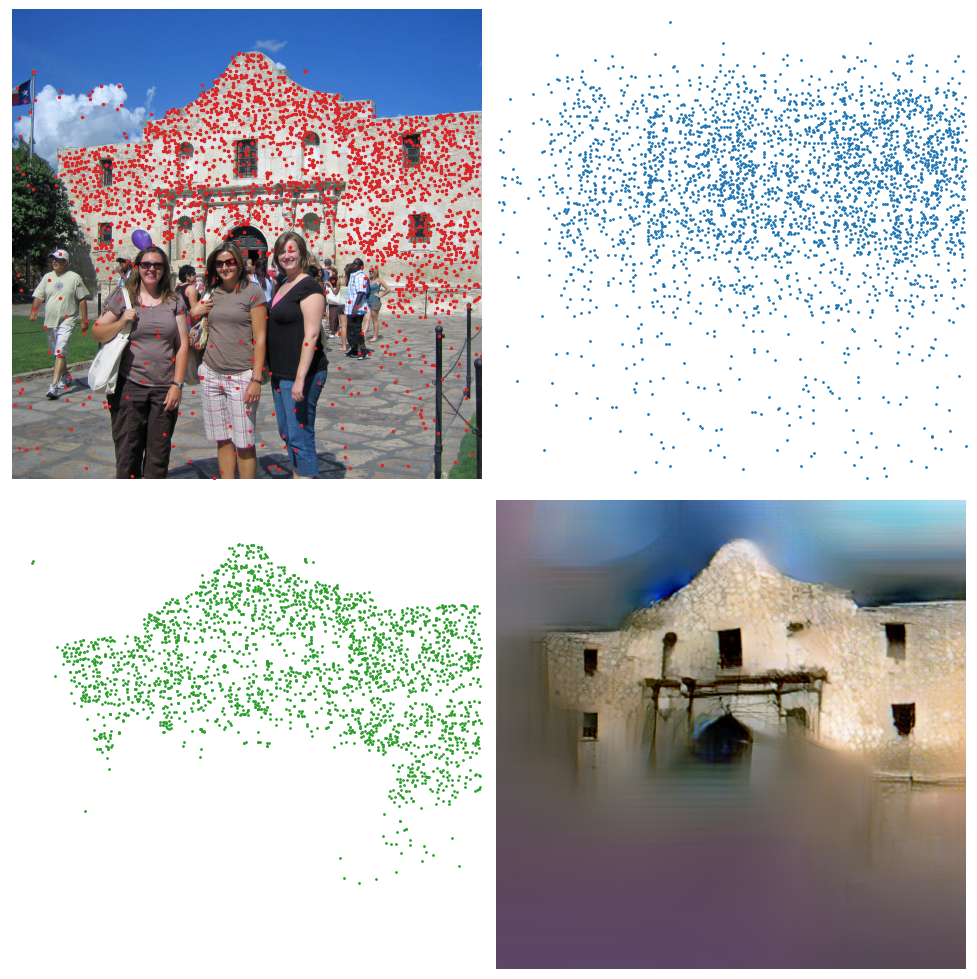
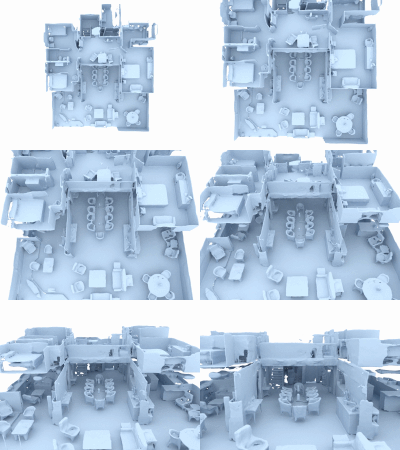
A system is presented that takes a single image as an input
(e.g. showing the interior of St.Peter's Basilica) and automatically
detects an arbitrarily oriented symmetry plane in 3D space. Given this
symmetry plane a second camera is hallucinated that serves as a virtual
second image for dense 3D reconstruction, where the point of view for
reconstruction can be chosen on the symmetry plane. This naturally creates
a symmetry in the matching costs for dense stereo. Alternatively, we
also show how to enforce the 3D symmetry in dense depth estimation for
the original image. The two representations are qualitatively compared
on several real world images, that also validate our fully automatic approach
for dense single image reconstruction.
We propose a new approach for structure from motion, where symmetry
relations in the 3D structure are automatically recovered from
multiple images and then imposed within a new constrained bundle
adjustment formulation that incorporates robust priors on the expected
model shape. Our approach significantly reduces drift through
"structural" loop closures and improves the accuracy of
reconstructions in urban scenes. We also use the discovered symmetries
to estimate a natural coordinate system and complete the 3D model.
|